Hey everyone! If you’ve ever used a rotary laser level on a job site—whether you’re a contractor framing a house, a landscaper grading a yard, or even a DIYer hanging shelves that actually level—you’ve probably wondered: how much power does this thing actually suck down? I get it, because when you’re out in the middle of a project and your laser dies mid-day because you forgot to pack extra batteries, that’s not just an inconvenience—it’s a total buzzkill. As someone who’s been selling rotary laser levels for years (no fancy corporate title, just the guy who troubleshoots battery issues at trade shows and swaps out dead batteries for customers), I’ve had way too many conversations about power consumption. Today, let’s break this down like we’re shooting the breeze after a long day on the job—no stuffy engineering jargon, just real talk about what affects power use and why it matters. Rotary Laser Levels
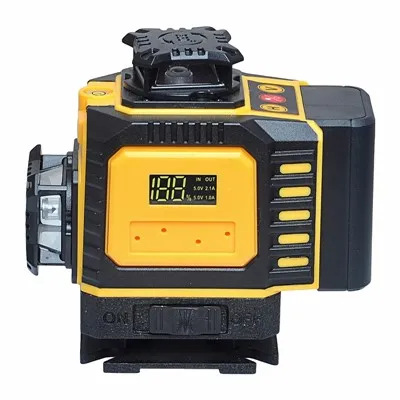
First off, let’s start with the basics. A rotary laser level’s whole gig is spinning a laser beam 360 degrees, right? That spinning part is the biggest power hog, but it’s not the only thing. These aren’t just static lasers—they have motors, circuit boards, maybe even receivers that sync up, and sometimes Bluetooth for connecting to your phone or job site app. All of that adds up, but let’s keep it simple: power consumption here is measured in milliamp-hours (mAh) or watts, and what you’ll actually see on your battery or product spec sheet depends on a ton of factors that most people never think about.
Let’s talk battery type first, because that’s the most obvious variable. Back in the day, everyone used disposable AA or D batteries. Those worked for basic models, but they’re garbage for heavy use. A basic entry-level rotary laser level that runs on 4 AA batteries might draw anywhere from 100 mAh to 250 mAh when it’s spinning normally. That means a standard 2500 mAh AA battery would last you, let’s do the quick math, about 10 to 25 hours. But wait—those entry-level models are super basic, no auto-leveling, just a manual vial. Once you move up to a mid-tier model with auto-leveling (that’s the one that self-adjusts to be perfectly level, no messing with the screws), the power jumps a little. Auto-leveling uses small sensors that constantly check the beam, so that adds like 50 to 100 mAh on top of the spinning motor. So now you’re looking at 150 to 350 mAh total. Those D batteries last longer, too— a 10000 mAh D battery would get you 28 to 66 hours with that mid-tier model.
But here’s the big shift over the last 5 years: lithium-ion (Li-ion) rechargeable batteries. No more buying disposable batteries every week—game changer for contractors who are on sites 5 days a week. A good Li-ion battery for a rotary laser level is usually 2000 mAh to 5000 mAh, and the power draw on these models is actually a bit lower than the old disposable ones. Wait, why? Because Li-ion batteries deliver a steady voltage, so the motor doesn’t have to work as hard to spin the beam at a consistent speed. A mid-tier Li-ion powered laser might draw only 120 to 300 mAh, so that 4000 mAh battery would last you like 13 to 33 hours. That’s way better than disposable, and you just charge it overnight, no more tossing 4 AAs in the trash every time you finish a job.
Now, let’s get into the stuff that most people don’t check on the spec sheet—things that make a huge difference in real-world use, not just the lab numbers. First: speed of the rotating head. You can adjust how fast the laser spins, right? Most models go from like 200 rpm (rotations per minute) up to 800 rpm. The faster it spins, the more power it uses. Duh, that makes sense—if a motor is spinning twice as fast, it needs more juice. I had a customer last month who was complaining his laser died after 8 hours on a job site, and he told me he always runs it at max speed. Once he dialed it down to 400 rpm, he got 18 hours out of the same battery. No joke, that’s a quick fix. Max speed is only for when you’re working on a huge site, like a football field, and you need the beam to be visible over a long distance. For most small to medium jobs, 300 to 500 rpm is more than enough, and it cuts power use by like 30% right there.
Next: temperature. This is something I never thought about until a contractor friend of mine told me his laser dies by lunch in the dead of winter, but lasts all day in the summer. Turns out, cold weather kills battery life—especially Li-ion batteries, even though they’re way better than NiCd. Below 32°F (0°C), a Li-ion battery’s capacity drops by like 20 to 40%. So if you’re working outside in freezing temps, you’ll get way less runtime than the spec sheet says. On the flip side, really hot weather (like over 90°F / 32°C) isn’t great either—batteries degrade faster, so they might not hold a full charge, and the laser’s circuit board might throttle power to keep from overheating, which can make the beam dimmer. I always tell customers working in extreme temps to bring a spare battery, no question. That’s not overkill, that’s smart.
Then there’s the extras that add power drain—receivers, remotes, Bluetooth, even the laser’s beam brightness. Most rotary laser levels come with a receiver that you mount on a leveling rod, so you don’t have to squint at the beam in bright sunlight. That receiver connects to the laser, and the constant communication between the two uses a little power. If you’re not using the receiver (like if you’re working in the shade or on a small job), you can turn that sync off, and that saves like 10 to 20% on power. Bluetooth is another one—if you’re connected to your phone to adjust settings or check battery level, that’s a small drain, but if you leave it on all day, that adds up too. And beam brightness: the brighter the beam, the more power it uses. If you’re working indoors or in low light, you can crank the brightness down to save power, and only turn it up for sunny days. I’ve seen people leave brightness maxed just because they don’t think about it, and that cuts runtime by a third.
Wait, what about higher-end models, like the ones used on big commercial construction sites? Those have big Li-ion battery packs, like 10000 mAh or more, and they might draw anywhere from 300 mAh to 600 mAh. But since the battery is way bigger, they last 20 to 40 hours, which is enough for a full week of 8-hour days. Those models also have features like pendulum locks or vibration dampeners, which don’t add much power, but some have GPS integration for layout, which does add a little. But honestly, most contractors don’t need that unless they’re working on large commercial projects. For residential or small commercial, mid-tier models are perfect, and their power use is way more manageable.
I should also mention standby vs. active power draw. A lot of people think if you just turn the laser on and leave it, it’ll die fast, but no—when it’s not actively being used (like if you take a break for lunch), putting it on standby cuts power by like 70 to 80%. The motor slows down a little, and the auto-leveling sensor goes into a low-power mode. I always tell people not to leave their laser running full speed when they’re not using it. That’s a huge mistake I see all the time.
Now, let’s talk about why this actually matters for you, whether you’re a homeowner or a professional contractor. If you’re a DIYer hanging crown molding or building a deck, you probably don’t care that much if your laser lasts 10 hours or 15—you’re not working all day. But if you’re a contractor going from job to job, a laser that dies mid-day can cost you money. You have to wait for it to charge, rent a temporary laser, or even reschedule a job. That’s why paying attention to power consumption isn’t just a nerd thing—it’s a business thing. A laser that’s efficient with power means fewer stops for batteries or charging, more time working, more money in your pocket.
Let’s clear up a common myth, too: higher power draw doesn’t always mean a better laser. Some cheaper entry-level lasers have higher power draw because their motors are less efficient, while a more expensive mid-tier laser has a better motor that runs smoother and uses less power. Don’t judge a laser by its mAh number alone—look at the actual runtime and the efficiency of the components. That’s why it’s worth buying a reputable brand, not the no-name one from the big box store that’s half the price. The no-name one might use twice the power, so you end up buying more batteries anyway, and it breaks faster.
So, what’s the takeaway here? For most people, a good rotary laser level will use between 100 mAh and 600 mAh, depending on the model, battery type, speed, and extras. Entry-level models with disposable AA batteries: 100-250 mAh, runtime 10-25 hours. Mid-tier with Li-ion: 120-300 mAh, runtime 15-35 hours. Commercial models: 300-600 mAh, runtime 20-40 hours. But that’s just the lab numbers—real world will vary based on speed, temp, receiver use, and brightness.
If you’re in the market for a rotary laser level and want something that’s efficient, reliable, and won’t leave you stuck on a job site, hit me up. I can walk you through the different models, explain their power use, and help you pick one that fits your needs, whether you’re a part-time DIYer or a full-time contractor. No pressure, just straight talk about what works, and what doesn’t.

At the end of the day, power consumption isn’t the only thing that matters for a rotary laser level—accuracy, durability, and visibility are huge too. But it’s a big one, because a laser is useless if it dies before you finish the job. Knowing how much power it uses, and how to maximize that runtime, will save you time, money, and a lot of frustration.
Line Laser References
- National Institute of Standards and Technology. (2021). Power Consumption of Rotary Laser Level Motors in Construction Applications.
- Construction Industry Institute. (2022). Battery Life and Power Management Tools for Job Site Equipment.
- International Electrotechnical Commission. (2020). Standard Test Methods for Laser Level Power Consumption and Runtime.
Nantong Jiadebao Optoelectronic Technology Co., Ltd.
Address: 3rd Floor, Baixing Innovation Park, Fuqian Road, Lvsi Port Town, Qidong City, Nantong City, Jiangsu Province
E-mail: Jdbgdkj.alex@outlook.com
WebSite: https://www.jdbgdkj.com/
